


Insights
The EU Transparency Revolution: Strengthening Consumer Protection and Fairness in Credit Agreements
Jan 26, 2026Consumer credit is one of the most closely watched topics in 2026, as businesses and regulators prepare for the full implementation of the revised EU Consumer Credit Directive (CCD II) next November. This landmark reform expands the scope of credit regulation to cover digital lending models such as Buy-Now-Pay-Later and microcredit, reinforcing transparency and affordability as central pillars of consumer protection.
Across the EU - and UK, transparency and fairness in credit agreements have become critical cross-border issues. Regulators are responding to rising concerns around indebtedness, digital marketing practices, and algorithmic decision-making in credit scoring. Against this backdrop, mandatory disclosure obligations remain the cornerstone of compliance, but the focus is shifting from formal information provision to ensuring genuine consumer understanding and informed decision-making.
The European Banking Authority's Consumer Trends Report for 2024/25, published in March 2025, underscores the urgency of these developments. The Report highlights three key challenges confronting EU consumers: payment fraud, rising indebtedness, and de-risking practices that disproportionately affect vulnerable and cross-border consumers. These challenges are not confined to EU borders - they resonate equally in the UK and across international markets.
The Foundations : Why Transparency Matters
Since the EU first developed its consumer law framework, mandatory disclosure obligations have emerged as the cornerstone of regulatory compliance for businesses operating in consumer markets. The EU legislator's approach rests on two fundamental assumptions: first, that information asymmetry creates structural market imbalances between traders and consumers; second, that enhanced disclosure can effectively influence consumer behaviour and market outcomes.
Credit plays a vital role in economic development, enabling consumers to purchase goods and services they cannot afford to pay for in full immediately. A well-functioning consumer credit market benefits consumers, manufacturers, sellers, and stimulates economic growth.
The transparency requirement is satisfied when the professional has provided the consumer with sufficient and accurate information enabling an average consumer, normally informed and reasonably attentive and prudent, to understand the concrete functioning of the financial mechanism in question and thus assess the risk of potentially significant negative economic consequences of such clauses on their financial obligations throughout the duration of the contract1.
Understanding Transparency: More Than Just Clear Language
Transparency is understood primarily as a concept related to the need for contractual clauses to be clear and easy to understand (formal transparency). Substantive transparency is also required, meaning not only must contract clauses be clear, but the consumer must understand the legal, economic, and other consequences of the terms.
Transparency must be material and not only grammatical. This requirement of clarity and intelligibility assumes that the consumer has benefited from sufficient information to make an informed decision, meaning the clause can be understood by an average consumer not only on a formal and grammatical level but also regarding its concrete scope.
Under EU case law, ‘The requirement of transparency [...] is satisfied when the professional has provided the consumer with sufficient and accurate information to enable a typical consumer, who is reasonably well informed and reasonably observant and circumspect, to understand the actual functioning of the financial mechanism in question and thus to assess the risk of the potentially significant adverse economic consequences of such terms on his financial obligations throughout the duration of the contract.2’
The European Framework: Building Consumer Protection
The evolution of EU consumer credit regulation spans five decades:
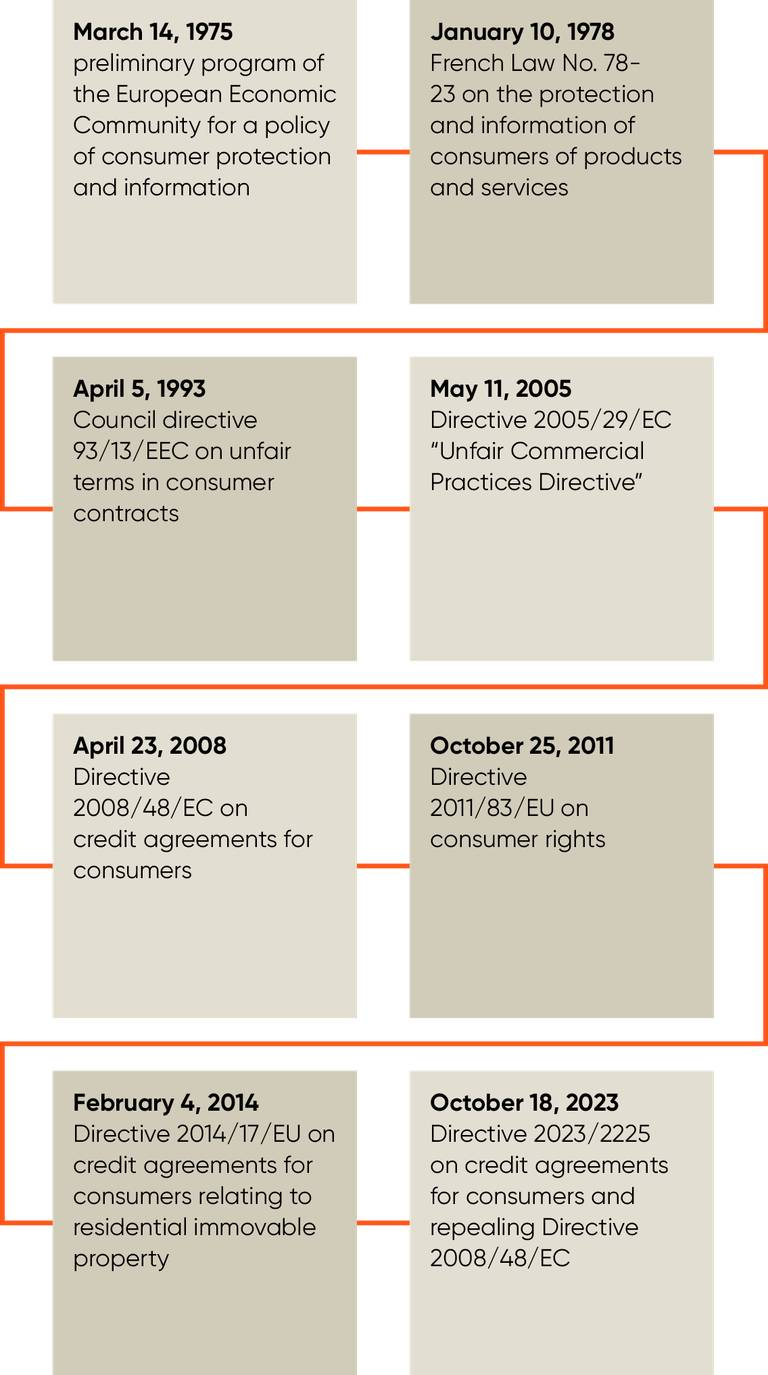
The revised CCD II represents the most significant reform of EU consumer credit regulation in over 15 years. Its expanded scope addresses the regulatory gaps exposed by the rapid growth of digital lending models that fall outside the framework of the 2008 Directive.
With less than 11 months until mandatory compliance - all consumer credit agreements must comply with the new regime by 20 November 2026, businesses offering consumer credit - or considering entering the market - should prioritise the following actions:
- Scope Assessment: Conduct a comprehensive review to determine whether products previously considered outside the CCD II now fall within scope.
- Documentation Overhaul: Update standard pre-contractual information forms (SECCI - Standard European Consumer Credit Information), credit agreements, and advertising materials to comply with enhanced disclosure requirements. The new CCD II mandates additional warnings about over-indebtedness risks and clearer presentation of total cost of credit.
- Creditworthiness Assessment Procedures: Review and enhance processes for assessing consumer creditworthiness. The CCD II strengthens obligations to verify consumers' ability to repay without experiencing financial distress, requiring access to relevant databases and consideration of income, expenditure, and existing commitments.
- Staff Training: Ensure customer-facing staff and credit intermediaries understand the new requirements, particularly the obligation to provide personalised explanations tailored to individual consumer circumstances.
- Systems and Technology: Upgrade IT systems to capture required data points, generate compliant documentation, and maintain appropriate records for supervisory review.
- Cross-Border Considerations: For businesses operating across multiple EU Member States, monitor national implementing legislation to identify any gold-plating or discretionary elements that vary by jurisdiction.
Early preparation is essential. Regulators across the EU have signaled that enforcement will be a priority from day one of the application date.
The Digitisation of Financial Markets: New Risks, New Rules
The consumer credit landscape has undergone radical transformation in the past decade. Digital-first lenders, algorithm-driven credit decisions, and seamless online application processes have democratised access to credit whilst simultaneously creating novel consumer protection challenges.
Three regulatory developments are reshaping how transparency obligations apply in digital environments: CCD II, the Digital Fairness Act, and the EU AI Act are converging to create a comprehensive framework for digital consumer credit that is unprecedented in its scope and ambition.
Compliance can no longer be siloed. Businesses must ensure that:
- Credit products are within regulatory scope (CCD II);
- Pre-contractual information and marketing comply with enhanced disclosure standards (CCD II);
- Digital interfaces avoid manipulative design (Digital Fairness Act) ;
- AI-driven processes are transparent, explainable, and non-discriminatory (EU AI Act);
- All elements work together to deliver genuine consumer understanding and informed decision-making.
Three Pillars of Transparency
1. Misleading Commercial Practices : actions and omissions
A commercial practice is misleading if it contains false information or, even if the information is factually correct, if it misleads the average consumer through its presentation. The practice must result in the consumer taking a ‘commercial decision that they would not have taken otherwise.3’ When assessing misleading practices by action, judges cannot take into account space or time limitations resulting from the medium used4.
A commercial practice is misleading if it omits material information that the consumer needs in order to make an informed commercial decision. It is also considered misleading when a trader hides material information or provides it in an unclear, unintelligible, ambiguous, or untimely manner, or when the trader fails to disclose their true commercial intent5. When assessing misleading practices by omission, the judge must take into account the context, including the limitations of the communication medium used, any space or time constraints it imposes, and the measures taken by the trader to provide the information by other means. This applies even if such disclosure is not explicitly required by national regulations.
In online credit marketing, the prohibition on misleading practices takes on heightened importance.
The revised CCD II strengthens the personalisation requirement significantly.
2. Duty to Inform: clarity, conciseness, prominence and information standardisation
The duty to inform operates at multiple stages: pre-contractual phase, contract drafting, contract execution. It does not stop at the conclusion of the contract!
Before the consumer is bound by a contract or credit offer, the lender must give them in good time the information necessary to compare different offers to make an informed decision. The lender must draw the consumer's attention to the essential characteristics of the credit(s) proposed and the consequences these credits may have on their financial situation, including in case of default.
This explanation must be personalised according to the consumer's situation. In particular, the EU Directives 2011/83 and 2023/2225 imposes on lenders and intermediaries to adapt their explanations to the personal situation of the consumer.
3. Unfair Terms: plainness and intelligibility
The EU Unfair Contract Terms Directive 93/13 obliges traders to offer fair and transparent standard contract terms to consumers. It requires all written contract terms to be drafted in plain, intelligible language and ambiguous terms to be interpreted in a manner most favourable to the consumer.
The requirement of transparency must be interpreted broadly, demanding that contract terms be formulated in a manner that makes them both formally and grammatically intelligible and reveals their economic consequences.
Three steps for analysing the unfairness of a clause:
- Does the clause pertain to the main subject of the contract? The main subject matter of the contract are those which organise the essential obligations of that contract.
- Is the clause clear and understandable? All contractual terms in consumer contracts must be drafted in plain and intelligible language - not just those relating to the main subject matter.
- Does the clause create a significant imbalance between the rights and obligations of the parties? The assessment involves identifying whether there is an imbalance between the rights and obligations of the parties, including an economic assessment.
Links Between the Three Pillars
A misleading commercial practice can lead to an unfair term6.
French Supreme Court aligns unfair terms regime with banker's duty to inform7.
As for the link between unfair commercial practices and duty to inform, there are unfair commercial practices involving the concealment of material information, as well as unfair commercial practices involving the commission of a false statement or misleading information that the seller or trader should have provided in accordance with their duty to inform.
These interconnections take on new significance in digital environments.
Regulators and courts are increasingly adopting holistic approaches that examine compliance across all three pillars simultaneously.
Cross-Border Implications and International Convergence
The challenges identified in the European Banking Authority's Consumer Trends Report for 2024/25- payment fraud, rising indebtedness, and financial exclusion through de-risking - transcend national borders and regulatory jurisdictions. For businesses operating across EU and UK markets, or serving cross-border consumers, these trends demand coordinated compliance strategies:
- Harmonised Standards: Where possible, adopt compliance approaches that satisfy both EU and UK requirements, recognising that regulatory divergence post-Brexit has been limited in consumer credit;
- Data Sharing and Verification: Establish processes for accessing and verifying consumer credit information across jurisdictions whilst respecting data protection rules;
- Vulnerable Consumer Protections: Implement enhanced safeguards that meet the highest standards across operating jurisdictions;
- Regulatory Dialogue: Engage proactively with supervisory authorities in each market to clarify expectations and demonstrate commitment to cross-border consumer protection?
The Path Forward
The principle of transparency serves as a cornerstone of consumer protection, requiring not merely formal compliance with information requirements but genuine understanding of economic consequences. As financial markets continue to evolve and digitalize, maintaining robust transparency standards whilst ensuring consistent interpretation across jurisdictions remains essential for protecting consumers and fostering confidence in credit markets.
The year 2026 represents a watershed moment. The convergence of CCD II implementation, AI Act obligations for high-risk systems, and emerging digital fairness standards creates both challenges and opportunities. Businesses that embrace this transformation - viewing transparency not as a compliance burden but as a competitive advantage that builds consumer trust - will be best positioned for sustainable success.
The transparency revolution is not merely about rules - it is about fundamentally rethinking the relationship between credit providers and consumers in an age of digital complexity. Those who succeed will be those who recognise that informed, empowered consumers are the foundation of stable, trustworthy credit markets.

Related capabilities
-
Financial Services Corporate & Regulatory Team
-
Litigation & Dispute Resolution