


Insights
Federal PFAS Regulation: 2025 Activities and 2026 Anticipated Actions
Feb 17, 2026Now that we have entered the second year of Administrator Zeldin’s tenure, BCLP looks back at EPA’s actions in 2025 and previews what regulated industry may expect in 2026. The timeline below highlights the regulatory changes BCLP monitored throughout 2025, and those items companies should continue to watch in 2026.
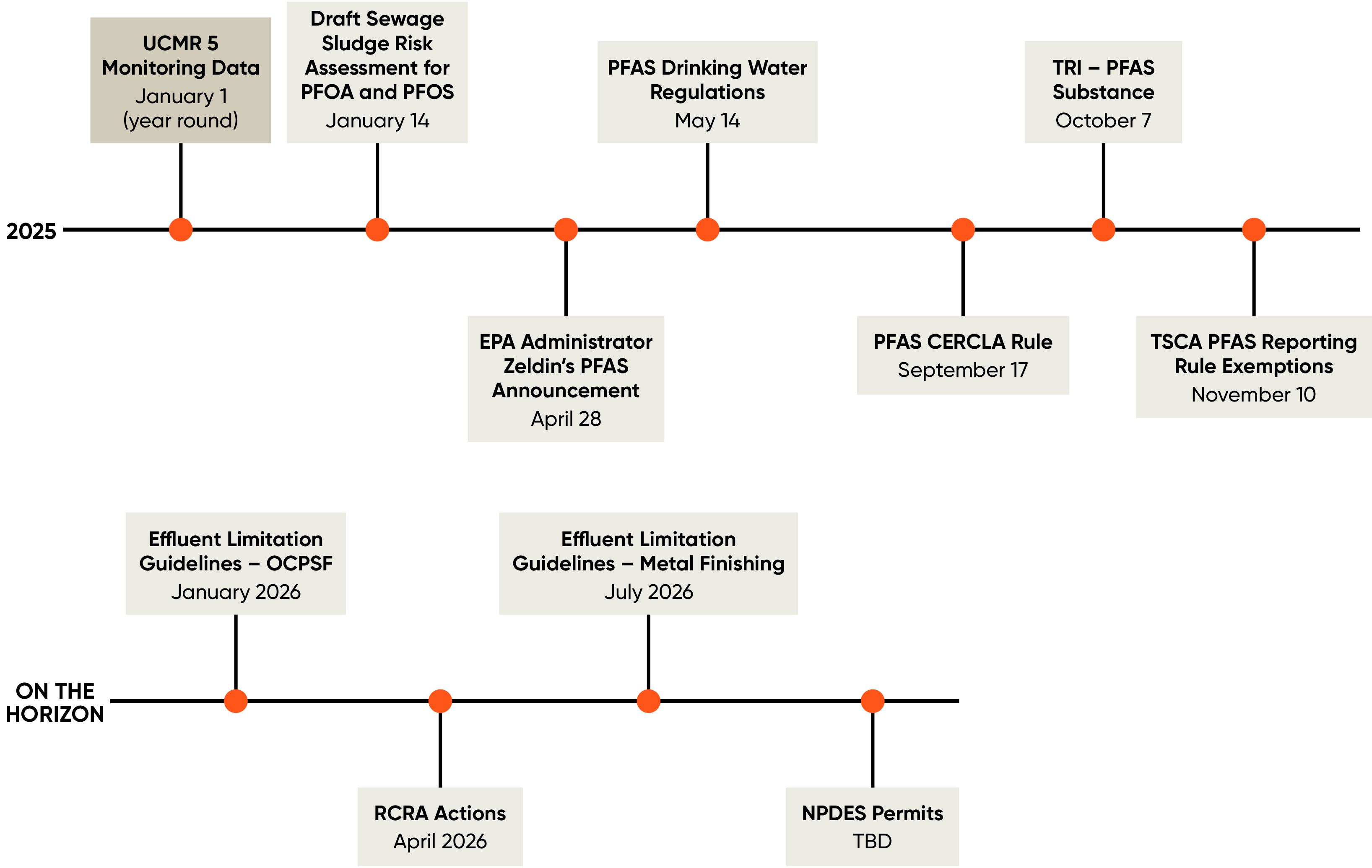
2025 EPA Actions
PFOA and PFOS Remain Designated under CERCLA
EPA retained the rule designating perfluorooctanoic acid (“PFOA”) and perfluorooctanesulfonic acid (“PFOS”) as “Hazardous Substances” pursuant to section 102(a) of the Comprehensive Environmental Response, Compensation, and Liability Act of 1980 (“PFAS CERCLA Rule”).
As discussed in BCLP’s Insight, the PFAS CERCLA Rule affects businesses in many different ways, including Phase I Environmental Site Assessments; impacting Potentially Responsible Party determinations; enabling site reopeners or modifications; administering reporting requirements; subjecting PFOA and PFOS to the Hazardous Materials Transportation Act; and triggering transfer requirements for government-owned property.
As of the date of publication, numerous parties have challenged the PFAS CERCLA Rule before the United States Court of Appeals District of Columbia Circuit. The PFAS CERCLA Rule has yet to be finalized.
Proposal to Rescind National PFAS Drinking Water Regulations
While EPA retained the PFAS CERCLA Rule, EPA proposed rescinding and reconsidering the PFAS Drinking Water limits and Hazard Index for four PFAS compounds (PFHxS, PFNA, PFBS, and HFPO-DA, commonly known as GenX). EPA retained only the 4 ppt Maximum Contaminant Levels (“MCLs”) for PFO and PFOS, Public water systems will now have an additional two years (until 2031) to comply with the MCL for PFOA and PFOS. BCLP’s Insight further discusses EPA’s decision, and EPA provides additional information at a related website.
As of the date of publication, EPA has not submitted a final rule changing the Drinking Water Regulations, and on January 21, 2026, a federal district court denied EPA’s proposal to vacate the drinking water limits, preserving the status quo until the court has briefing on the merits. BCLP discussed these commitments in a past Insight.
This chart demonstrates how EPA proposes to adjust the regulations established on April 10, 2024:
| Compound | Final MCL (enforceable levels) |
| PFOA | 4.0 ppt |
| PFOS | 4.0 ppt |
|
|
|
|
|
|
TSCA PFAS Reporting Rule Revisions
EPA is requiring businesses that manufacture or import PFAS chemicals, or have manufactured or imported PFAS chemicals in the past, to submit a significant amount of information to EPA during an eleven-year period from 2011 to 2022. The rule became final in October 2023, and the reporting period has been postponed – now opening in 2026.
EPA delayed the implementation of this rule (repeatedly), and the data submission period will now for most reporting entities will now run from April 13, 2026, through October 13, 2026. BCLP’s Insight, among other things, provides information regarding the information that a business needs to submit.
Most recently, EPA proposed six exemptions to the Toxic Substances Control Act PFAS Reporting Rule (“TSCA PFAS Reporting Rule”). The single most impactful proposed exemption relates to eliminating reporting requirements for imported articles (i.e., finished goods). Additional proposed exemptions relate to eliminating or reducing reporting requirements for certain byproducts, non-isolated intermediates, and impurities; research and development initiatives; and incorporating a de minimis exemption in mixtures or products. BCLP’s recent Insight provides additional information.
The final TSCA PFAS Reporting Rule has not yet been issued and, is expected to be published in June of 2026.
Draft Biosolids Guidance
EPA published the “Draft Sewage Sludge Risk Assessment for Perfluorooctanoic Acid (PFOA) and Perfluorooctane Sulfonic Acid (PFOS)” (“Draft Risk Assessment”). As of the date of publication, it is unclear when EPA will issue a Final Risk Assessment.
The Draft Risk Assessment does not establish any enforceable limits for PFAS substances in biosolids, but it provides data for both state regulators and businesses that interact with biosolids.
Toxic Release Inventory (“TRI”) Reporting
EPA announced the addition of another PFAS substance subject to Toxic Release Inventory Reporting (“TRI Reporting”). As of the date of publication, 206 PFAS substances are included in the entire TRI program. If applicable, businesses are responsible for submitting the necessary reports by July 1, 2026. EPA may list additional PFAS substances in the TRI Reporting program in 2026.
EPA also states that it is developing a program to list PFAS substances and PFAS categories in the TRI list of toxic chemicals. The website states that “EPA is evaluating comments received on the proposed rule published on October 4, 2024, and will consider how to address PFAS compound categories and what events may trigger the automatic addition of a PFAS to the TRI.”
Unregulated Contaminant Monitoring Rule (“UCMR”)
According to EPA, regulated Public Water Systems (“PWS”) monitored for 29 PFAS substances during a 12-month period beginning in January 2023 and ended in December 2025. UCMR 5 recently completed its tenth submission in this program; it claims to be approximately 95% complete.
EPA provided a detailed summary of the data assessed in the UCMR program, and intends to update this information quarterly. Significantly, UCMR 5 results do not indicate whether PWSs complied with the MCLs.
At the time of publication, the scope of the following UCMR program (UCMR 6) is unclear. PWSs have already raised concerns about the testing costs and the limited availability of qualified laboratories, making compliance with the UCMR program a continued burden for regulated PWS entities.
2026 Anticipated Actions
Resource Conservation and Recovery Act (“RCRA”)
EPA stated that it intends to finalize a proposed rule designating nine PFAS compounds (and their salts and structural isomers) to the list of RCRA Hazardous Constituents in April 2026.
Additionally, EPA stated that it plans to finalize its proposed rule expanding upon RCRA's statutory definition of Hazardous Waste to apply to corrective actions at solid waste management units.
EPA provides information regarding these proposed RCRA actions in three separate sources: 1) a 2024 press release; 2) a website addressing the Proposal to List Nine PFAS Compounds as RCRA Hazardous Constituents; and 3) and a website addressing the Proposal to Clarify Authority to Address Releases of Hazardous Waste at Treatment, Storage, and Disposal Facilities.
National Pollutant Discharge Elimination System (“NPDES”) Permits
NPDES Permits are general permits, often without site-specific terms, that manage stormwater discharges from industrial facilities. In November 2025, EPA intended to propose an update to NPDES Permits to require permit applications to include monitoring and reporting for PFAS discharges, but has not done so yet as this is not a final rule.
In that vein, EPA published a draft multi-sector general permit (”MSGP”) in 2025, but it has not been finalized. The draft MSGP would require operators in 23 industrial sectors to monitor for 40 PFAS compounds quarterly. Notably, the MSGP applies only to areas where EPA is the NPDES permitting authority (e.g., MA, NH, NM, the District of Columbia, and certain federal facilities).
Effluent Limitations Guidelines (“ELGs”)
ELGs establish industry-specific wastewater standards, largely utilizing the best available technologies. Facilities are not legally required to use the specific technologies that EPA identifies in the ELGs; however, facilities must comply with the established discharge limits.
EPA intends to propose revisions to the Organic Chemicals, Plastics and Synthetic Fibers (“OCPSF”) Effluent Limitations Guidelines (January 2026) and the Metal Finishing Effluent Limitations Guidelines (July 2026) to address PFAS discharges from manufacturing facilities. These actions directly relate to Plan 15 of the Effluent Guidelines Program.
For more information on PFAS chemicals, related regulatory requirements and the transactional and liability considerations that these chemicals pose, please visit our PFAS webpage. If you have a question about changing PFAS regulations or how these changes may impact your company’s operations, please contact Erin Brooks, Christian Bromley, Bryan Keyt, Brittainy Cavender, John Kindschuh, or any other member of our PFAS team at BCLP.