


Insights
PFAS State Snapshot: Illinois
Apr 30, 2026Illinois regulates per- and polyfluoroalkyl substances (“PFAS”) in groundwater; drinking water; firefighting foam; personal protective equipment for firefighters (“PPE”); and various consumer products.
In 2025, Illinois revised the groundwater standards for PFAS and regulated PFAS in five consumer products, adding to the state’s existing firefighting foam provisions. In 2026, Illinois also updated the drinking water standards, largely to reflect certain standards at the federal level.
This Client Insight reflects the status of PFAS regulations in Illinois in environmental media, firefighting foam, PPE, and in consumer products as of April 14, 2026.
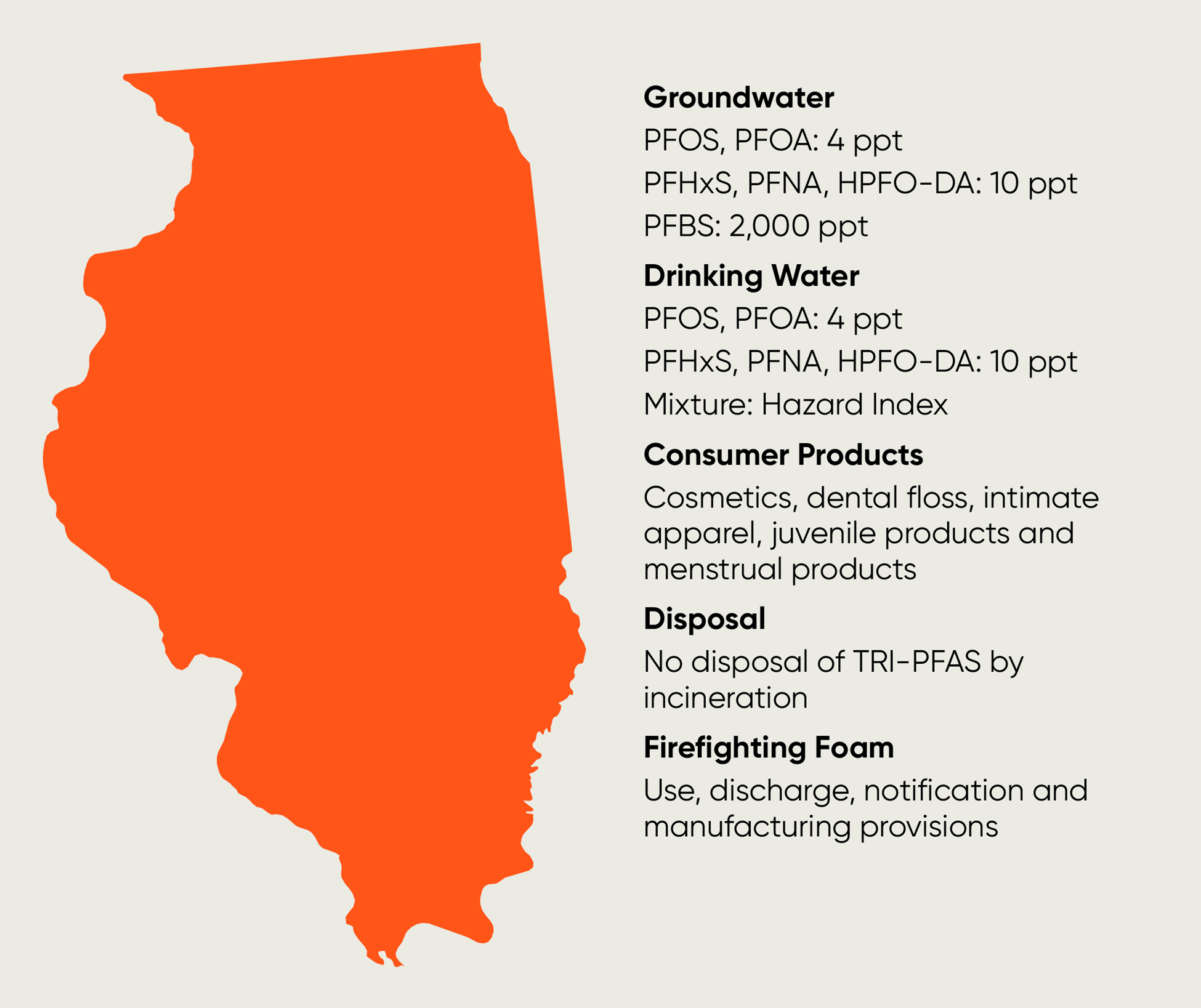
Illinois Administrative Code (“IAC”) establishes regulations for groundwater quality. In 2025, the Illinois Pollution Control Board (“IPCB”) adopted amendments establishing enforceable groundwater quality standards for the six PFAS compounds below. These standards generally align with the April 2024 U.S. Environmental Protection Agency (“EPA”) Maximum Contaminant Levels (“MCLs”) for drinking water.
35 IAC Part 620 establishes various aspects of groundwater quality, including the methods of classification, standards for groundwater quality, and various procedures for groundwater management and protection. In 2025, the IPCB updated the groundwater quality standards for six PFAS substances:
| PFAS | Ground Quality Standard (ng/L or ppt) |
|
Perfluorooctanesulfonic acid (“PFOS”) |
4 ppt |
| Perfluorooctanoic acid (“PFOA”) | 4 ppt |
| Perfluorohexanesulfonic acid (“PFHxS”) | 10 ppt |
| Perfluorononanoic acid (“PFNA”) | 10 ppt |
| Hexafluoropropylene oxide dimer acid (“HFPO-DA” or “GenX”) | 10 ppt |
| Perfluorobutanesulfonic acid (“PFBS”) | 2000 ppt |
Illinois Environmental Protection Agency (“Illinois EPA”) Groundwater Quality Protection Information
Illinois EPA PFAS General Information (including Groundwater)
In 2026, the IPCB adopted amendments to the state’s Primary Drinking Water Standards. The amendments update Illinois’ rules to be comparable to the 2024 U.S. EPA Drinking Water regulations. Specifically, Illinois established enforceable MCLs for five PFAS substances and adopted a Hazard Index approach for mixtures.
35 IAC Part 611 establishes the primary drinking water standards for Illinois public water supplies. In 2024, U.S. EPA established new regulations for six PFAS substances, and in 2026, the IPCB also enacted enforceable MCLs for numerous PFAS substances:
| PFAS | Final MCL |
| PFOS | 4 ppt |
| PFOA | 4 ppt |
| PFHxS | 10 ppt |
| PFNA | 10 ppt |
| HFPO-DA or GenX | 10 ppt |
| Mixtures containing two or more of PFHxS, PFNA, HFPO-DA, and PFBS | 1 (unitless) Hazard Index |
The Hazard Index is the sum of risk ratios (fractions) for mixtures of those PFAS analytes is at or below 1.
U.S. EPA PFAS Drinking Water Regulations
First Provision: Illinois Administrative Code, 415 ILCS 170 et al. (2021, firefighting foam; 2026, PPE), establishes use, discharge, notification, and manufacturing provisions for firefighting foam and PPE containing intentionally added PFAS.
- A “person, local government, fire department, or State agency” may not use a Class B firefighting foam containing intentionally added PFAS for training or testing purposes, subject to some exceptions.
- “Intentionally added PFAS” is defined as “PFAS that are deliberately added during the manufacture of a product if the continued presence of the PFAS is desired in the final product or desired in one of the product’s components to perform a specific function in the final product. ‘Intentionally added PFAS’ does not include PFAS that are present in the product due to use of water containing PFAS if the manufacturer took no action that resulted in the PFAS being present in the water.”
- A manufacturer may not “knowingly manufacture, sell, offer for sale, distribute for sale, or distribute for use in this State” a Class B firefighting foam containing intentionally added PFAS, subject to some exceptions.
- A “person, unit of local government, fire department, or State agency” must notify the Illinois Emergency Management Agency within 48 hours of the release of Class B firefighting foam containing intentionally added PFAS.
- Illinois EPA shall establish a “take-back program for fire departments that use and store firefighting foam containing PFAS.” The program shall continue for five years or until no firefighting foam containing PFAS is reported.
- Any “person, firm, association, partnership, corporation, organization, or joint venture, including an importer or domestic distributor of firefighting agents or firefighting equipment,“ that sells PPE containing any PFAS substances to any “person, local government, or State agency” shall provide written notice to the purchaser at the time of sale.
- Beginning January 1, 2027, any “person, local government, or State agency shall not knowingly manufacture, sell, offer for sale, distribute for sale, or distribute for use in the State” any PPE containing intentionally added PFAS chemicals.
Second Provision: Illinois Public Act 102-1048 (2022): Establish certain incineration prohibitions, such as no person shall dispose of any TRI-PFAS by incineration.
- No person “shall dispose of any TRI-PFAS by incineration,” including aqueous film-forming foam that contains TRI-PFAS.
- Exceptions to incineration under this Act:
- Landfill gas from the decomposition of waste that may contain PFAS substances at a permitted sanitary landfill;
- Landfill gas in a landfill gas recovery facility that is located at a sanitary landfill;
- Waste at a permitted hospital, medical, and infectious waste incinerator; or
- Sludges, biosolids, or other solids or by-products generated at or by a municipal wastewater treatment plant or facility.
Definitions:
- “Incineration includes, but is not limited to, burning, combustion, pyrolysis, or the use of an acid recovery furnace or oxidizer, ore roaster, cement kiln, lightweight aggregate kiln, industrial furnace, boiler, or process heater. ‘Incineration’ does not include the use of a thermal oxidizer as a pollution control or resource recovery device of a facility that is using perfluoroalkyl or polyfluoroalkyl substances or chemicals containing perfluoroalkyl or polyfluoroalkyl substances.”
- “Toxic Release Inventory Perfluoroalkyl or Polyfluoroalkyl Substances” or "TRI PFAS” means "the chemicals" on the list of perfluoroalkyl or polyfluoroalkyl substances set forth in the USEPA’s Toxic Release Inventory rules, developed under Section 313 of the federal Emergency Planning and Community Right-To-Know Act (EPCRA) and codified in 40 CFR 372.65, excluding liquid or gaseous fluorocarbon or chlorofluorocarbon products used chiefly as refrigerants.”
Illinois Fire Chiefs Association Information
Illinois Public Act 102-0290 (2025) establishes prohibitions regarding cosmetics if the product contains intentionally added PFAS.
Beginning on January 1, 2032, a person may not sell or distribute cosmetics if the product contains intentionally added PFAS.
Definitions:
- “Cosmetics” means products, including soap, that are:
-
- “intended to be rubbed, poured, sprinkled, or sprayed on, introduced into, or otherwise applied to the human body or any part of the human body for the purpose of cleansing, beautifying, promoting attractiveness, or altering the appearance;” or
- a component of any product.
- “Intentionally added PFAS” means “PFAS that are deliberately added during the manufacture of a product if the continued presence of the PFAS is desired in the final product or desired in one of the product’s components to perform a specific function in the final product. ‘Intentionally added PFAS’ does not include PFAS that are present in the product due to use of water containing PFAS if the manufacturer took no action that resulted in the PFAS being present in the water.”
- “Perfluoroalkyl substance or polyfluoroalkyl substance” or “PFAS” means “a class of fluorinated organic chemicals containing at least one fully fluorinated carbon atom.”
Illinois Public Act 102-0290 (2025) establishes prohibitions regarding juvenile products if the product contains intentionally added PFAS.
Beginning on January 1, 2032, a person may not sell or distribute juvenile products if the product contains intentionally added PFAS.
Definitions:
-
“Juvenile product" means a product designed or marketed for use by infants and children under 12 years of age. "Juvenile product" includes a baby or toddler foam pillow, bassinet, bedside sleeper, booster seat, changing pad, child restraint system for use in a motor vehicle and aircraft, co-sleeper, crib mattress, highchair, highchair pad, infant bouncer, infant carrier, infant seat, infant sleep positioner, infant swing, infant travel bed, infant walker, nap cot, nursing pad, nursing pillow, play mat, playpen, play yard, polyurethane foam mat, pad, or pillow, portable foam nap mat, portable infant sleeper, portable hook-on chair, soft-sided portable crib, stroller, and toddler mattress.
- "Juvenile product" does not include:
- a children’s electronic product, including a personal computer, audio and video equipment, calculator, wireless phone, game console, handheld device incorporating a video screen, or any associated peripheral component, such as a mouse, keyboard, power supply unit, or power cord;
- an adult mattress; or
- an internal component of a product that does not come into direct contact with a child’s skin or mouth during reasonably foreseeable use or abuse of the product.”
- “Intentionally added PFAS” means “PFAS that are deliberately added during the manufacture of a product if the continued presence of the PFAS is desired in the final product or desired in one of the product's components to perform a specific function in the final product. ‘Intentionally added PFAS’ does not include PFAS that are present in the product due to use of water containing PFAS if the manufacturer took no action that resulted in the PFAS being present in the water.”
- “Perfluoroalkyl substance or polyfluoroalkyl substance” or “PFAS” means “a class of fluorinated organic chemicals containing at least one fully fluorinated carbon atom.”
Illinois Public Act 102-0290 (2025) establishes prohibitions regarding dental floss, intimate apparel, and menstrual products if the product contains intentionally added PFAS.
Beginning on January 1, 2032, certain consumer products may not be sold or distributed if the product contains intentionally added PFAS include:
- Dental Floss;
- Intimate Apparel; or
- Menstrual Products.
Definitions:
- “Dental floss” means “a cord or cords of thin filaments used in interdental cleaning to remove debris and dental plaque from between teeth.”
- “Intimate apparel” means “garments intended to be worn under clothes, usually with direct contact with skin. ‘Intimate apparel’ includes bras, boxers, briefs, shapewear, sleepwear, thermals, loungewear, socks, and stockings.”
- “Intentionally added PFAS” means “PFAS that are deliberately added during the manufacture of a product if the continued presence of the PFAS is desired in the final product or desired in one of the product’s components to perform a specific function in the final product. ‘Intentionally added PFAS’ does not include PFAS that are present in the product due to use of water containing PFAS if the manufacturer took no action that resulted in the PFAS being present in the water.”
- “Menstrual product” means “a product used to collect menstruation and vaginal discharge, including tampons, pads, sponges, menstruation underwear, disks, and menstrual cups, whether disposable or reusable.”
- “Perfluoroalkyl substance or polyfluoroalkyl substance” or “PFAS” means “a class of fluorinated organic chemicals containing at least one fully fluorinated carbon atom.”
For more information on PFAS chemicals and the relevant regulatory and litigation considerations, please visit our PFAS webpage. If you have a question about how to manage PFAS considerations in Illinois, or any other jurisdiction, please contact Erin Brooks, Bryan Keyt, Thor Ketzback, Jonathan Chu, John Kindschuh, or any other member of our PFAS team at Bryan Cave Leighton Paisner LLP.
Related capabilities
-
PFAS